
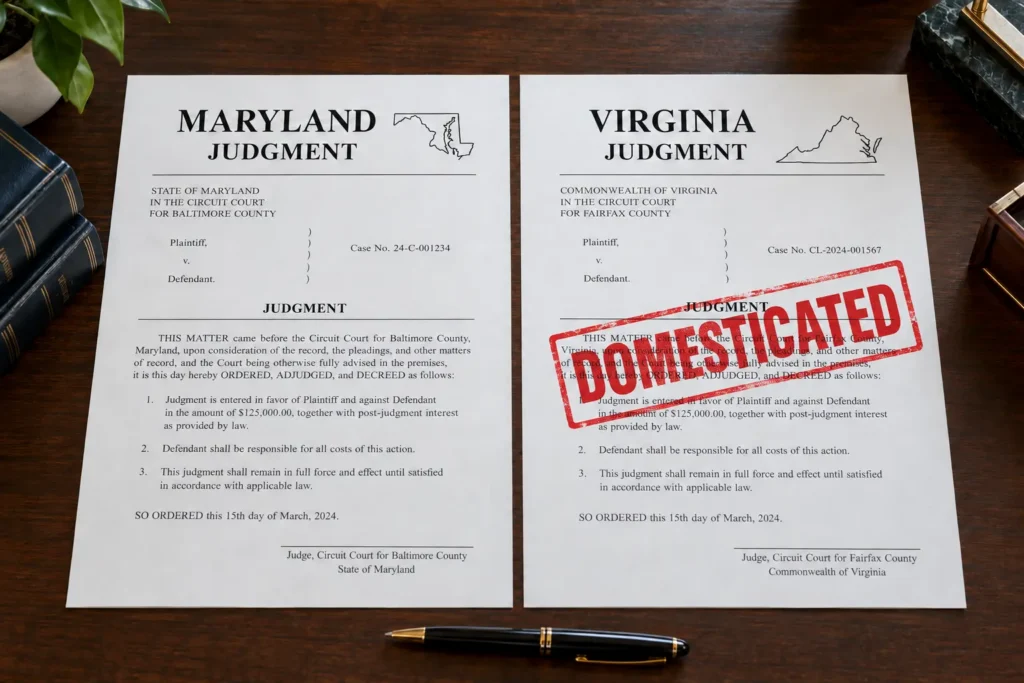
Why Domesticate a Judgment?
Obtaining a judgment against someone does not necessarily mean you will automatically receive the money you are owed. A judgment establishes your legal right to collect, but the debtor may not simply hand over a check. In many cases, you have to take additional steps to enforce the judgment and recover the money.
This can become more complicated when the debtor has assets in another state. For example, you may have obtained a judgment in Maryland, but the debtor owns real estate, has income, or maintains other assets in Virginia. A Maryland court generally cannot directly enforce its judgment against assets located in Virginia, so you may need to use the Virginia courts to reach them.
In that situation, you generally need to domesticate the Maryland judgment in Virginia. Domesticating the judgment essentially brings the out-of-state judgment into Virginia so that you can use the Virginia courts and collection tools available under Virginia law.
Once the judgment is properly domesticated, you may be able to pursue remedies such as garnishments, debtor interrogatories, levies, and other judgment-enforcement procedures.
Domesticating the Judgment Creates a Lien on the Debtor’s Real Property
Domesticating an out-of-state judgment in Virginia can create a judgment lien against the debtor’s real property. This lien can bean effective enforcement tool, particularly when the debtor owns valuable real estate.
The lien may allow the creditor to recover the amount owed from the debtor’s equity when the property is sold, refinanced, or otherwise transferred, subject to the priority rights of other creditors.
Accordingly, if you have reason to believe that a debtor owns real estate in a particular Virginia county or city, identifying the appropriate jurisdiction in which to domesticate and docket the judgment is a critical step in developing an effective collection strategy.
Why Can One State Enforce Another State’s Judgment?
The ability to enforce a judgment across state lines is rooted in the Full Faith and Credit Clause of the U.S. Constitution, which generally requires states to recognize the judicial proceedings and judgments of other states.
The Uniform Enforcement of Foreign Judgments Act, which has been adopted in Virginia, provides a procedure for bringing a qualifying judgment from another state into Virginia for enforcement.
The idea is that it would be unnecessarily inefficient and costly for a judgment creditor to have to start the underlying lawsuit all over again simply because the debtor has moved or assets are located in another state. Instead, the creditor can use the applicable domestication procedure to have the existing judgment recognized and enforced in the new state.
Out-of-State Judgments are Domesticated in Virginia Circuit Courts
In Virginia, an out-of-state judgment is domesticated through the Clerk’s Office of the Circuit Court for the county you are seeking to domesticate the judgment in. The process generally involves filing the necessary documents, presenting an exemplified or triple-seal copy of the judgment from the out-of-state court, and paying the required filing fee.
The exact process and timeline can vary from one circuit court to another. Every Circuit Court Clerk’s Office has its own processing timeline, so there is no single statewide turnaround time. Generally, I would expect the domestication process to take approximately four to six weeks.
The Intricacies of Domesticating a Judgment
There are certain intricacies involved in domesticating a judgment and it is important it is done correctly. Where the judgment is domesticated, how it is docketed, and what amount is claimed can all matter. Taking the time to get these details right at the beginning can help avoid problems later in the collection process.
It is particularly important to account for the proper judgment amount, including amounts that are legally recoverable and properly accrued. Interest, costs, and other amounts may need to be calculated and presented correctly when the judgment is brought into Virginia.
In other words, domesticating the judgment is not simply about getting the judgment into Virginia. It is about getting it into Virginia correctly so that you can effectively enforce it.
The Bottom Line
If you have a judgment from another state and the debtor has property, income, or other assets in Virginia, domesticating the judgment may be an important step toward actually collecting the money you are owed.
A properly domesticated and docketed judgment can create a lien against the debtor’s real property in the Virginia county or city where the judgment is docketed, while also providing a foundation for pursuing other available collection remedies.
And because there are important intricacies involved, doing it incorrectly can create problems or leave money on the table.
Experience With Judgment Domestication and Collection
I have experience domesticating judgments from out-of-state state and federal courts in Virginia, as well as pursuing collection after the judgment has been domesticated.
If you have a judgment that you would like to explore domesticating or collecting in Virginia, schedule a consultation to discuss your options.
Learn about my debt collection practice.
Disclaimer: Every case is different. The information provided is for general informational purposes and is not legal advice. You should speak with a qualified attorney about the specific facts of your situation to determine your rights and legal options.